
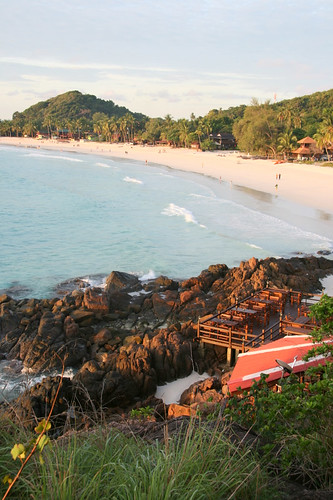
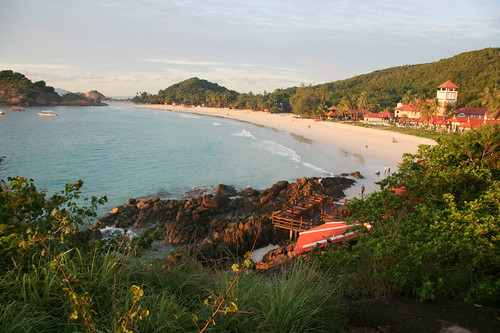
Make sure that you bring a camera.with and extra role of two. The trail is well marked and trodden as this place is a favourite path for local and some staff on the island that you may meet during they morning Jog. During you journey you may encounter a small stream and a pool alive with local Catfish,If you are lucky u may encounter Redang’s unique wildlife but harmless animals such as the shy Kancil “mousedeer” looking for food .(please don’t surprise or scare them as the Kancil here are can easily day offright...No..joking.!!) .
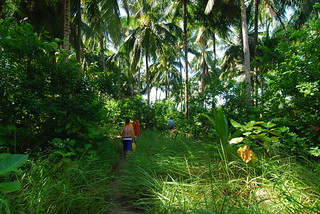
Sometimes there might be long tailed macaque monkey hanging on the trees staring at you,sometime on the tree you can find flying squire, along the way you will see many wonder that are created by the mother earth and also a very beautiful and scenic view of The tranquil and isolated bay of Berjaya Redang Beach Resort is accompanying by snowy white sandy beach . the trail will end at Berjaya Redang Resort

Following the properly sealed road will lead you to the “Kampung Nelayan” Redang Fishing village.The village here you can find house that are Centered around a small mosque which sits up on a small hill. You can find a mamak stall or local Restaurant for some humble food for a change , Mee Goreng (Fried Noodle) , a cup of KoPi Kaw ( coffee ),or you could tried the famous Nasi lemak and Roti Canai here .
The Marine Park of Pulau Redang and its headquarter is cited on Pulau Pinang which is in
southern of Redang Island . Here is the where officer and patrol boat
from Department of Fisheries of Malaysia are place to protect the marine
park to inspect and supervise all activities in this area. There are
also a few chalets that are built overseeing the sea which can be rent
and enjoy by only government civil servants.
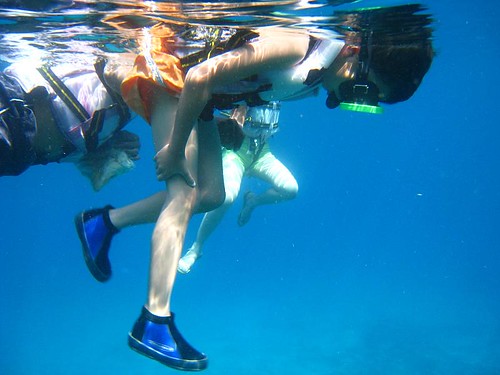
The sea here are very calm that u don’t need to be a good swimmer that u can go rent a life jacket , snorkel, and diving gear at any resort and jump into the sea (except no jumping at the Marine park)
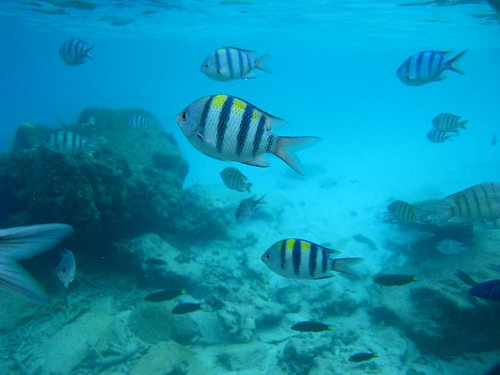
There is also a protected marine park at Island, which many people found enjoying for snorkelling, in Redang Marine Park, you can find a many colourful array of spectacular marine life . There are small and big eel to be find living here amid the coral, giant black and brown grouper, black tipped shark. you may also encounter with the some or lonely Green sea turtle and Hawksbill sea turtle, pufferfish, angelfish, damselfish; eels; giant clams; rays, sea urchins, sea cucumbers .
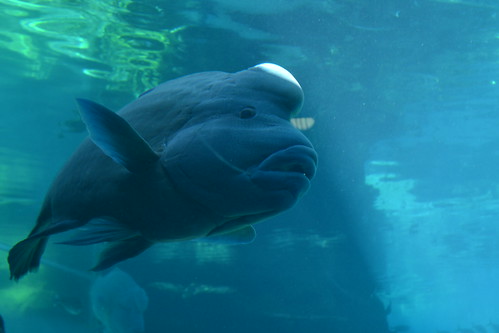
Don’t be scare if u bump into with our “Bapok Bayan” a The Biggest Green Humped parrot fish in Redang Marine Park, who usually frequent here with its gruesome teeth and a big lump on its forehead that forage coral. This particular ”Ikan Bayan” is at the size of a small build man, making the shark here look very harmless : P
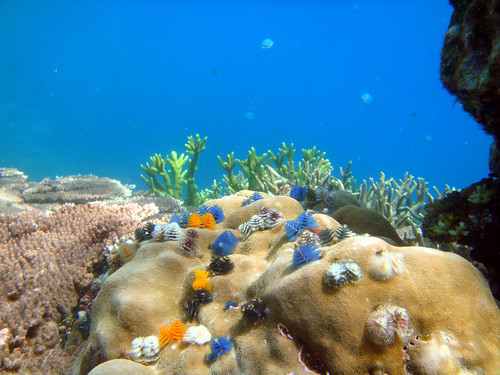
In the protected marine park, there are corals of every imaginable shape, size or color like multicoloured Christmas trees coral, standing like a guardian to the sea. Who will fold up and retract back into the rock and them gracefully popping back again. or Staghorn Coral field, some very big size clamp ( never touch them or it will owned You!!) , taupe shape coral, nudibranch with reef shark, stingrays and other small fish brightly lit like neon bulbs.
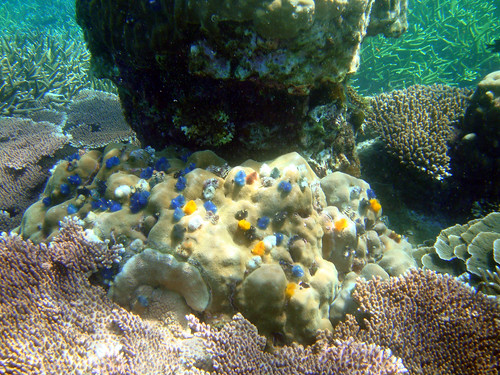
If you are sharp-eyed diver, will be rewarded with sights of flatworm, shrimp, squid, cuttlefish, stonefish, Dangerous Lionfish, lobster and pipefish.


A word of caution to visitors: No fishing is allowed within a 3.2 km radius of the island and any Fishing, damaging and removing of corals and other marine life are strictly prohibited and the penalty for breaking the law includes jail and fine.
The sea here are very calm that u don’t need to be a good swimmer that u can go rent a life jacket , snorkel, and diving gear at any resort and jump into the sea (except no jumping at the Marine park)
There is also a protected marine park at Island, which many people found enjoying for snorkelling, in Redang Marine Park, you can find a many colourful array of spectacular marine life . There are small and big eel to be find living here amid the coral, giant black and brown grouper, black tipped shark. you may also encounter with the some or lonely Green sea turtle and Hawksbill sea turtle, pufferfish, angelfish, damselfish; eels; giant clams; rays, sea urchins, sea cucumbers .
Don’t be scare if u bump into with our “Bapok Bayan” a The Biggest Green Humped parrot fish in Redang Marine Park, who usually frequent here with its gruesome teeth and a big lump on its forehead that forage coral. This particular ”Ikan Bayan” is at the size of a small build man, making the shark here look very harmless : P
In the protected marine park, there are corals of every imaginable shape, size or color like multicoloured Christmas trees coral, standing like a guardian to the sea. Who will fold up and retract back into the rock and them gracefully popping back again. or Staghorn Coral field, some very big size clamp ( never touch them or it will owned You!!) , taupe shape coral, nudibranch with reef shark, stingrays and other small fish brightly lit like neon bulbs.
If you are sharp-eyed diver, will be rewarded with sights of flatworm, shrimp, squid, cuttlefish, stonefish, Dangerous Lionfish, lobster and pipefish.

The Jetty of the Marine Park


The beach at Taman Laut Pulau Redang

A word of caution to visitors: No fishing is allowed within a 3.2 km radius of the island and any Fishing, damaging and removing of corals and other marine life are strictly prohibited and the penalty for breaking the law includes jail and fine.

Laguna Redang Resort
As a bleesing ,I was not the only one that felt that way, as a couple of year ago a big and magnificent resort was build here, The Laguna Redang Island Resort are the only resort built here. The low-rise resort retains a ‘modern paradise concept” that cleverly infuses Terengganu ‘s traditional Malay architecture with modern amenities and yet is in perfect harmony with the natural greenery. that even I who went they at august 04, cant help at marvelling at the unique and finely design of the resort which has 300 rooms and suites (with private balcony) either fronting the beach or a well-landscaped garden that are touched its designer, the well-known Terengganu-born royalties and architect HNR Prince YM Raja Datuk Kamarul Bahrin Shah.
If you are going to Laguna Redang Island Resort, you will love the dining experience at the seaview Ala-Carte Restaurant which serve local and continental cuisine and after dinner you can enjoy a walk along the beach under the beautiful and panoramic view of the stars.

The resorts also have a nice open disco, private karaoke lounges and indoor beach club which features live entertainment that u will enjoy and they have such a nice staff.
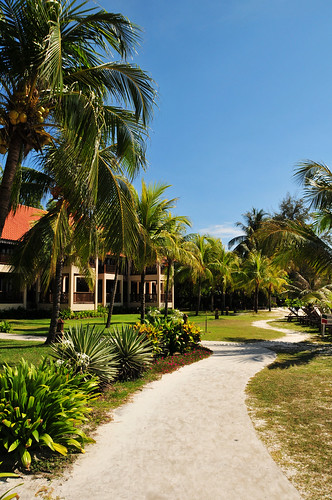


From my experience you will find a lot of thing to do here that are provided by the resort like Snorkelling,island excursion, a sunset cruise, Fishing trip or diving trip in the day or night, thre are also a lot of recreational water sport that u can join or a jungle trekking from where u are to Teluk Dalam on the otherside of the island.
In 1960s Turtle Watching at Rantau Abang, Terengganu become world famous after several international magazine wrote about the abundance of sea turtle found landing at the beach here to lay their egg. It became a sensation later as more and more people coming to the place ans was soon become was well-known tourist attraction around the world. Two decade later in the 80's the number of turtles landed there were decreasing rapidly because of man made activities through shipping and fishing activities around the world and a few year later tourist complete stop coming to the area anymore.
There are still several place for visiter to find sea turtle landing activities in Terengganu.
Icluding a beach where Kemaman Tourist Guide operate a turtle watching activities in the area and visiting the local Sea Turtle Hatchery at Kemaman.
Bellow are extracted taken from Kemamamguide.com
The Beach also know as Monica Bay, in Geliga Terengganu, provides one of the great attractions in Kemaman. I believed the turtles landed at new area which is Monica Bay, Geliga.


~Hatchery Area~

~Green Turtle in the House~
Location:

Monica Bay, Geliga in Kemaman District
Fact :
Turtles are reptiles of the order Testudines (the crown group of the superorder Chelonia), characterised by a special bony or cartilaginous shell developed from their ribs that acts as a shield.”Turtle” may either refer to the Testudines as a whole, or to particular Testudines which make up aform taxon that is not monophyletic.
The order Testudines includes both extant (living) and extinct species. The earliest known turtles date from 215 million years ago, making turtles one of the oldest reptile groups and a more ancient group than lizards, snakes and crocodiles. Of the many species alive today, some are highlyendangered.
Like other reptiles, turtles are ectotherms—their internal temperature varies according to the ambient environment, commonly called cold-blooded. However, leatherback sea turtles have noticeably higher body temperature than surrounding water because of their high metabolic rate.
Like other amniotes (reptiles, dinosaurs, birds, and mammals), they breathe air and do not lay eggs underwater, although many species live in or around water. The largest turtles are aquatic.(Taken from Wikipedia)
Facilities:

~Baby Turtle “flying” on my hand… ~
A shed will be provided to tourist while waiting for the turtle.
Tourist will just need to make early booking and what we will do is we will call the tourist at night once the turtles landing. Turtle nesting process requires about 3 hours after landing on the beach. Only qualified nature guides are allowed to enter the turtle nesting area in order to control the number of tourists who come every night, to make it not too crowded. Too many tourists will attract the turtles attention of our presence and will stop looking for spawning areas and will lead them back to the sea.
Tourists are advised to check-in hotels around Cherating or Kemaman area if interested to watch the turtles because tourists do not need to wait for the turtles at the beach. Turtle egg collectors or “Rangers” that recognized and authorised by the department of fisheries (Jabatan Perikanan) are allowed and they will tell the nature guides if there is a turtle landing and nature guide will call the tourist to come to the beach to see the turtle. This procedure is to avoid too many visitors to come to the beach at one time and will disturb the turtle and its habitat.
Activities :
Tourist can see the turtle only after the turtle laying eggs process finished which means after the turtle dig a hole and began laying eggs. And this process will take about half an hour. Turtle will cover the hole after the turtle nesting process and getting ready to return to the sea. We will accompany the turtles to the edge of the water and waved goodbye to the turtle. However, visitors are prohibited to stand in front of the turtle while it crawls to the sea.
You will be lucky if there are eggs that hatched on the day as you can release hatchlings into the sea from a distance of 10 meters from the edge of the water. This is because the hatchlings require adequate strength before it entered the water. Hatchlings have the energy for 7 days for them to seek refuge in the sea. But in fact, only one baby turtle will survive in 1000 hatchlings that hatch because it has too many enemies such as birds, big fish, fishing net and etc.
If the nature guide did not call tourists to come to the beach before 12 midnight, this means that no turtles have landed on that night.
Want to know more information? Please do come to Kemaman, Terengganu to watch the turtle with authorised local nature guide….
Turtle Watching Session :

~Briefing time…~

~Watch turtles laying eggs process… ~

~Sand Bathing~


~Accompanying the turtle back to sea…~

~Photo session with the baby turtle … (Their mothers so cute, right?? )~
)~
Hatchlings release Session – Must not Miss!!

>Get Set……. <


"Goooo…….. Gooooooooo………"

"I am number one.. " " I am number one.."

**** I Winn!!!!……. ****

By Car
Tour guide will call you if there any signs of turtle’s landing and will inform the check-point to meet. This is because we do not know where the turtles lay their eggs at that night you make booking.
After that, your tour guide will take you to the location where the turtles lay their eggs, but tourists are not allowed to go near to the turtle before getting the signal from the tour guide.
__________________________________________________________________
MOST IMPORTANT
Recommendation if you are in Kemaman between feb - September
Dont forget to visit Kampung Ibok's Firefly Sanctuary for Fireflies watching activities

Run by kemamanguide.com
The Sungai Yak Yah Firefly Sanctuary is the biggest fire sanctuary in Malaysia. Which is located about half an hour from the town of Chukai in Kemaman. The Yak Yah river is also the home to the biggest firefly colonies found in Malaysia.
The appreciation activities can be done all around the year except from the month of October to January and the best time to go here for firefly appreciation activities is from July to September, which is the mating season for the firefly.

There are still several place for visiter to find sea turtle landing activities in Terengganu.
Icluding a beach where Kemaman Tourist Guide operate a turtle watching activities in the area and visiting the local Sea Turtle Hatchery at Kemaman.
Bellow are extracted taken from Kemamamguide.com
The Beach also know as Monica Bay, in Geliga Terengganu, provides one of the great attractions in Kemaman. I believed the turtles landed at new area which is Monica Bay, Geliga.


~Hatchery Area~
~Green Turtle in the House~
Location:

Monica Bay, Geliga in Kemaman District
Fact :
Turtles are reptiles of the order Testudines (the crown group of the superorder Chelonia), characterised by a special bony or cartilaginous shell developed from their ribs that acts as a shield.”Turtle” may either refer to the Testudines as a whole, or to particular Testudines which make up aform taxon that is not monophyletic.
The order Testudines includes both extant (living) and extinct species. The earliest known turtles date from 215 million years ago, making turtles one of the oldest reptile groups and a more ancient group than lizards, snakes and crocodiles. Of the many species alive today, some are highlyendangered.
Like other reptiles, turtles are ectotherms—their internal temperature varies according to the ambient environment, commonly called cold-blooded. However, leatherback sea turtles have noticeably higher body temperature than surrounding water because of their high metabolic rate.
Like other amniotes (reptiles, dinosaurs, birds, and mammals), they breathe air and do not lay eggs underwater, although many species live in or around water. The largest turtles are aquatic.(Taken from Wikipedia)
Facilities:

~Baby Turtle “flying” on my hand… ~
A shed will be provided to tourist while waiting for the turtle.
Tourist will just need to make early booking and what we will do is we will call the tourist at night once the turtles landing. Turtle nesting process requires about 3 hours after landing on the beach. Only qualified nature guides are allowed to enter the turtle nesting area in order to control the number of tourists who come every night, to make it not too crowded. Too many tourists will attract the turtles attention of our presence and will stop looking for spawning areas and will lead them back to the sea.
Tourists are advised to check-in hotels around Cherating or Kemaman area if interested to watch the turtles because tourists do not need to wait for the turtles at the beach. Turtle egg collectors or “Rangers” that recognized and authorised by the department of fisheries (Jabatan Perikanan) are allowed and they will tell the nature guides if there is a turtle landing and nature guide will call the tourist to come to the beach to see the turtle. This procedure is to avoid too many visitors to come to the beach at one time and will disturb the turtle and its habitat.
Activities :
Tourist can see the turtle only after the turtle laying eggs process finished which means after the turtle dig a hole and began laying eggs. And this process will take about half an hour. Turtle will cover the hole after the turtle nesting process and getting ready to return to the sea. We will accompany the turtles to the edge of the water and waved goodbye to the turtle. However, visitors are prohibited to stand in front of the turtle while it crawls to the sea.
You will be lucky if there are eggs that hatched on the day as you can release hatchlings into the sea from a distance of 10 meters from the edge of the water. This is because the hatchlings require adequate strength before it entered the water. Hatchlings have the energy for 7 days for them to seek refuge in the sea. But in fact, only one baby turtle will survive in 1000 hatchlings that hatch because it has too many enemies such as birds, big fish, fishing net and etc.
If the nature guide did not call tourists to come to the beach before 12 midnight, this means that no turtles have landed on that night.
Want to know more information? Please do come to Kemaman, Terengganu to watch the turtle with authorised local nature guide….
Turtle Watching Session :

~Briefing time…~

~Watch turtles laying eggs process… ~

~Sand Bathing~


~Accompanying the turtle back to sea…~

~Photo session with the baby turtle … (Their mothers so cute, right??
)~Hatchlings release Session – Must not Miss!!

>Get Set……. <


"Goooo…….. Gooooooooo………"

"I am number one.. " " I am number one.."

**** I Winn!!!!……. ****
How to Get There :

By Car
Tour guide will call you if there any signs of turtle’s landing and will inform the check-point to meet. This is because we do not know where the turtles lay their eggs at that night you make booking.
After that, your tour guide will take you to the location where the turtles lay their eggs, but tourists are not allowed to go near to the turtle before getting the signal from the tour guide.
__________________________________________________________________
MOST IMPORTANT
Recommendation if you are in Kemaman between feb - September
Dont forget to visit Kampung Ibok's Firefly Sanctuary for Fireflies watching activities

Run by kemamanguide.com
The Sungai Yak Yah Firefly Sanctuary is the biggest fire sanctuary in Malaysia. Which is located about half an hour from the town of Chukai in Kemaman. The Yak Yah river is also the home to the biggest firefly colonies found in Malaysia.
The appreciation activities can be done all around the year except from the month of October to January and the best time to go here for firefly appreciation activities is from July to September, which is the mating season for the firefly.

The discovery of the Inscribed Stone in Kuala Berang, Hulu Terengganu is significant for Terengganu which proven the earliest acceptance of Islam by a state ruler in the Malay Peninsular. There is Memorial Batu Bersurat built in Kampung Buluh in Kuala Berang to commemorate the discovery of the stone. The Batu Bersurat monument located at Kampung Ladang roundabout is beautifully landscaped and serves as yet another landmark monument for visitors arriving into Kuala Terengganu Heritage Waterfront City
 |
(above Picture from http://tourism.terengganu.gov.my) |
Batu Bersurat Roundabout - The discovery of
the Inscribed Stone in Kuala Berang, Hulu Terengganu is significant for
Terengganu which proven the earliest acceptance of Islam by a state
ruler in the Malay Peninsular. There is Memorial Batu Bersurat built in
Kampung Buluh in Kuala Berang to commemorate the discovery of the stone.
The Batu Bersurat monument located at Kampung Ladang roundabout is
beautifully landscaped and serves as yet ...

 Bukit Puteri -Walkway on top of Bukit Puteri
Bukit Puteri (the hill of the Princess) or Princess hill, covered an
area of 0.688 hectares and is 200 meters in heights, is situated just
beside the Istana Maziah and the General Post Office in Kuala Terengganu
City ...
Bukit Puteri -Walkway on top of Bukit Puteri
Bukit Puteri (the hill of the Princess) or Princess hill, covered an
area of 0.688 hectares and is 200 meters in heights, is situated just
beside the Istana Maziah and the General Post Office in Kuala Terengganu
City ...
Pasar Besar Kedai Payang is a must-visit especially for the first-time visitors to
this Sea turtle state (Negeri Penyu). Located just a few minutes walk
north along the pier from the inter-city bus station and Located just by
the Sungai Terengganu (Terengganu River).
Pasar Besar Kedai Payang (Payang ‘s Big Market Shop) or Pasar Payang in
short (also known as Central Market)
The Floating Mosque of The East - Masjid Tengku Tengah Zaharah (Tengku Tengah Zaharah Mosque) which is
situated about 4Km from Kuala Terengganu Centre, is built on a floating
platform and is also known as the "The Floating Mosque of the East" due
to its unique design that creates an illusion of itself as floating on
water. This magnificent and unique Mosque are named after ...
Crystal Mosque of Terengganu

'Taman Tamadun Islam' is an interactive journey of Islamic monuments of
the world. It is an entertainment and educational destination. The
Sanderson Design Group was asked to provide the initial conceptual
designs for the project and following the clients approval of these has
now been engaged to complete the final design drawings, leading to the
construction that has began in 2006.
The initial scope involves
Taman Tamandun Islam Pulau Wan Man ( Islamic Civilisation Park)
 A park sprawling over
33ha, the Islamic Civilization Park of Pulau Wan Man is one of the state’s most distinguished
attractions. Featuring impressive edifices and intricate craftsmanship, the Island's park
takes visitors on a spellbinding tour of the finest in Islamic architecture.
A park sprawling over
33ha, the Islamic Civilization Park of Pulau Wan Man is one of the state’s most distinguished
attractions. Featuring impressive edifices and intricate craftsmanship, the Island's park
takes visitors on a spellbinding tour of the finest in Islamic architecture.
The park’s icon is
the glittering crystal mosque, a grand structure made of steel and glass.
Kampung Cina
Kampung
Cina
Foreword
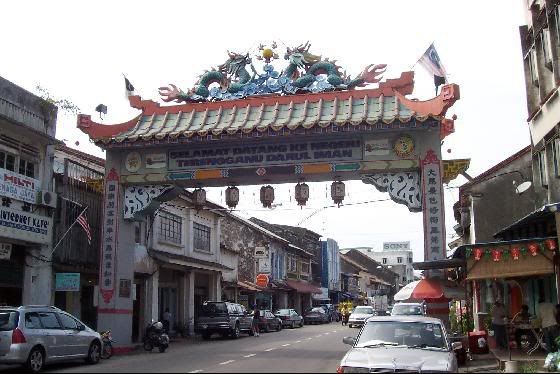
Kampung Cina literary mean Chinese Village and are also called Little
Chinatown by foreigner.
Kampung Cina is one of Southeast Asia’s most enchanting early Chinese
settlements in the world heritage where amidst colour and clutter, one
can discovers stately ancestral homes, temples, townhouses, and sundry
shops
Most of the description that were given out to tourist was not correct
and wasn’t ...
Terengganu State Museum

The Main Entrance of Museum Losong
Terengganu State Museum Complex.
The Biggest Museum in South East Asia .Normally known by the local as
Museum Losong which is prized by the people of Terengganu. As the
largest museum in the South East Asia that houses century's worth of
historical artefacts and artworks are a must visit by anyone visiting
Terengganu.
Just 3km south of Kuala Terengganu towards Losong, and you
...

The recreation park
is a preferred place for weekend holiday
retreats in Kuala Terengganu.
Feel the cool breeze while strolling on the wide stretch of sandy beach
overlooking South China
Sea. A children‟s playground, horse riding activity,
jogging tracks, toilets,
eating stalls and
performance ...


